Birth Cost Recovery in Wisconsin
What do we know about Birth Cost Recovery?
There is very limited research on how Birth Cost Recovery impacts people in Wisconsin, or other communities. Some have contested that Birth Cost Recovery may deter those giving birth from obtaining prenatal care and voluntarily establishing paternity. However, these claims have not been proven and remain theoretical.
Prior research does show that Birth Cost Recovery collections are linked to lower employment rates and lower earnings among low-income Wisconsin fathers (Cancian, Heinrich, & Chung, 2013). Fathers made to pay Birth Cost Recovery are also less likely to comply with child support orders (Bartfeld, 2005). This was also the case when we evaluated the impact of Dane County’s decision to cease new Birth Cost Recovery collections: elimination of Birth Cost Recovery collections increased fathers’ compliance with child support orders and increased the amount of money going to the mother and child(ren) (Green, Cook, & Vu, 2023). The findings reveal an urgent need for policy reform and deeper scrutiny of contemporary poverty governance.
Over the last 4 years, REAL has been working toward filling the knowledge gap.
What is Birth Cost Recovery?
Birth Cost Recovery is a policy that holds some non-custodial fathers accountable for repaying the government for the cost of their child’s publicly funded birth. Title IV-D of the federal Social Security Act allows states to decide if and how to carry out Birth Cost Recovery. Through the policy, non-custodial fathers are charged with a debt to “recover” labor and delivery expenses that were initially paid for by public insurance (Medicaid).
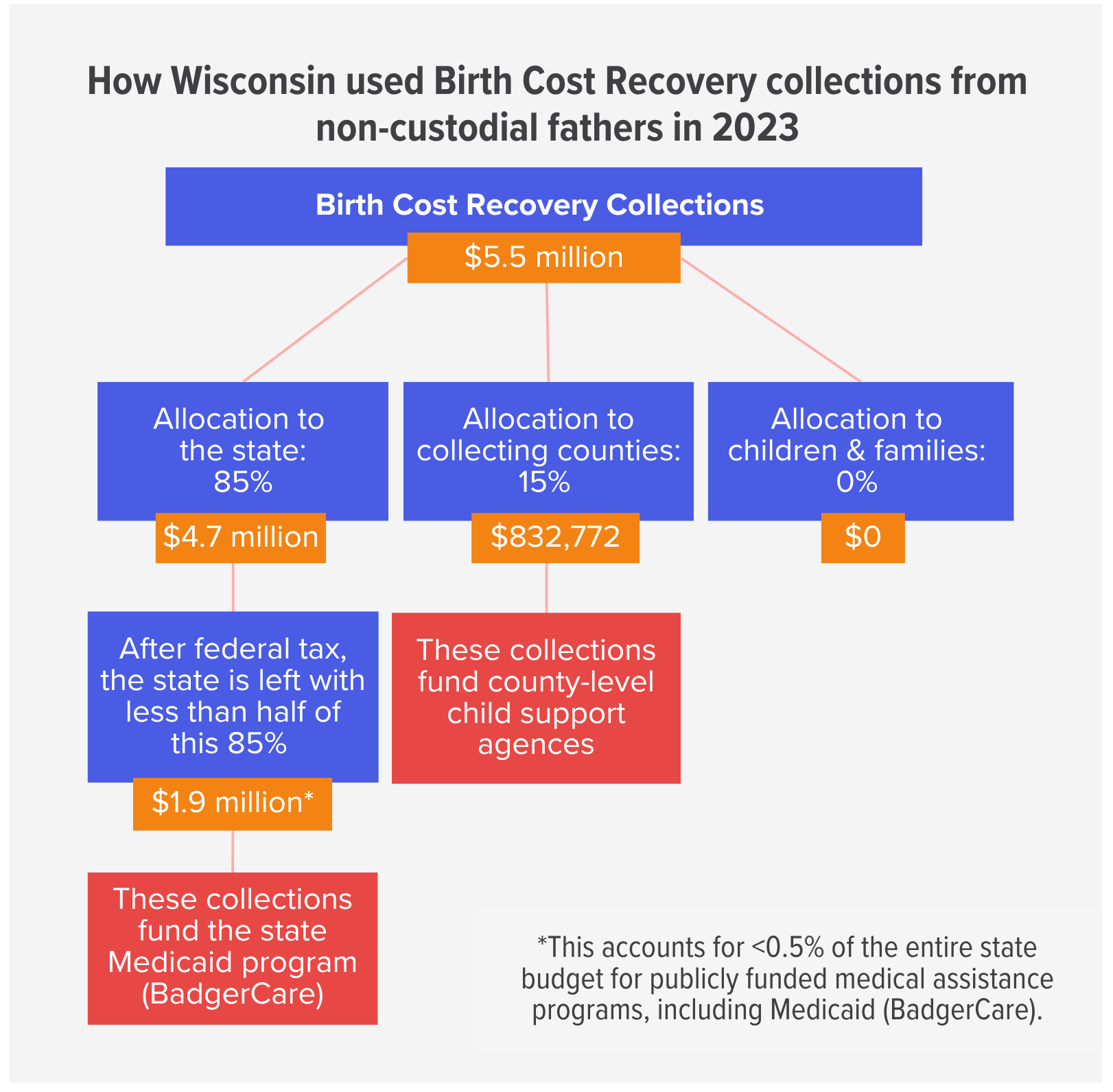
In Wisconsin, county child support agencies and courts work together to determine Birth Cost Recovery debts when they establish non-custodial fathers’ child support orders. Importantly, the impacted children and mothers do not receive any of the recovered funds. The state uses the recouped funds to support the Medicaid (BadgerCare) program, and the counties use the funds to support their child support programs.
Wisconsin is one of two remaining US states that still enforce Birth Cost Recovery and has historically been the top enforcer of Birth Cost Recovery in the US, collecting more than $193 million from non-custodial fathers from 2011 to 2023. In 2023 alone, the state collected $5.5 million in Birth Cost Recovery from fathers.
A Note on Language: We refer to male parents as “father(s)” and female parents or birthing parents as “mother(s).” We acknowledge that not all parents identify with these labels.
Recent Birth Cost Recovery Policy Changes in Wisconsin
| Year | Policy Change |
|---|---|
| 2019 | Wisconsin Legislature updates administrative code for Birth Cost Recovery rules to include an exception for an “intact family”, where if the parents are unmarried, but living together they are not subject to the policy |
| 2019 | Dane County ceases new Birth Cost Recovery orders |
| 2023 | Milwaukee County discontinues new Birth Cost Recovery orders |
| 2023 | Dane County works to eliminate outstanding Birth Cost Recovery debt ordered prior 2020 |
| 2024 | Milwaukee County eliminates all existing Birth Cost Recovery orders, relieving 32,000 fathers in Milwaukee county of $67 million of debt |
| 2025 | Governor Evers includes elimination of Birth Cost Recovery in the proposed biennium 2025-27 state budget |
| 2025 | Final state budget does not include funding to end Birth Cost Recovery — the practice continues in all counties except Dane and Milwaukee Counties |
Featured Resources
Penalizing Parenthood and Perpetuating Poverty: Black Parents’ Perspectives on Wisconsin’s Birth Cost Recovery Policy
In early 2026, Dr. Laura Swan led a peer-reviewed manuscript to the Journal of Racial and Ethnic Health Disparities.
Abstract: Social safety-net policies and programs are often a double-edged sword—they provide necessary resources, but also punish poor Americans. In Wisconsin, one policy that exemplifies this pattern is Birth Cost Recovery, a state-enforced cost recovery policy through which unmarried, non-custodial fathers are required to repay Medicaid-covered delivery expenses. Supporters assert that Birth Cost Recovery promotes paternal responsibility and increases the sustainability of safety-net programs, but opponents contend it has detrimental effects on families. Yet few studies have explored Birth Cost Recovery, leaving policymakers with an inadequate understanding of its consequences. To address this knowledge gap, we conducted semi-structured interviews with Black parents in Wisconsin (N = 40), a population that is disproportionately affected by Birth Cost Recovery policies. Interviewers asked parents about their experiences with Birth Cost Recovery, their views on the policy, and its impact on their families. Applying the Sort and Sift, Think and Shift approach to thematic analysis, we identified three themes (Figure below).
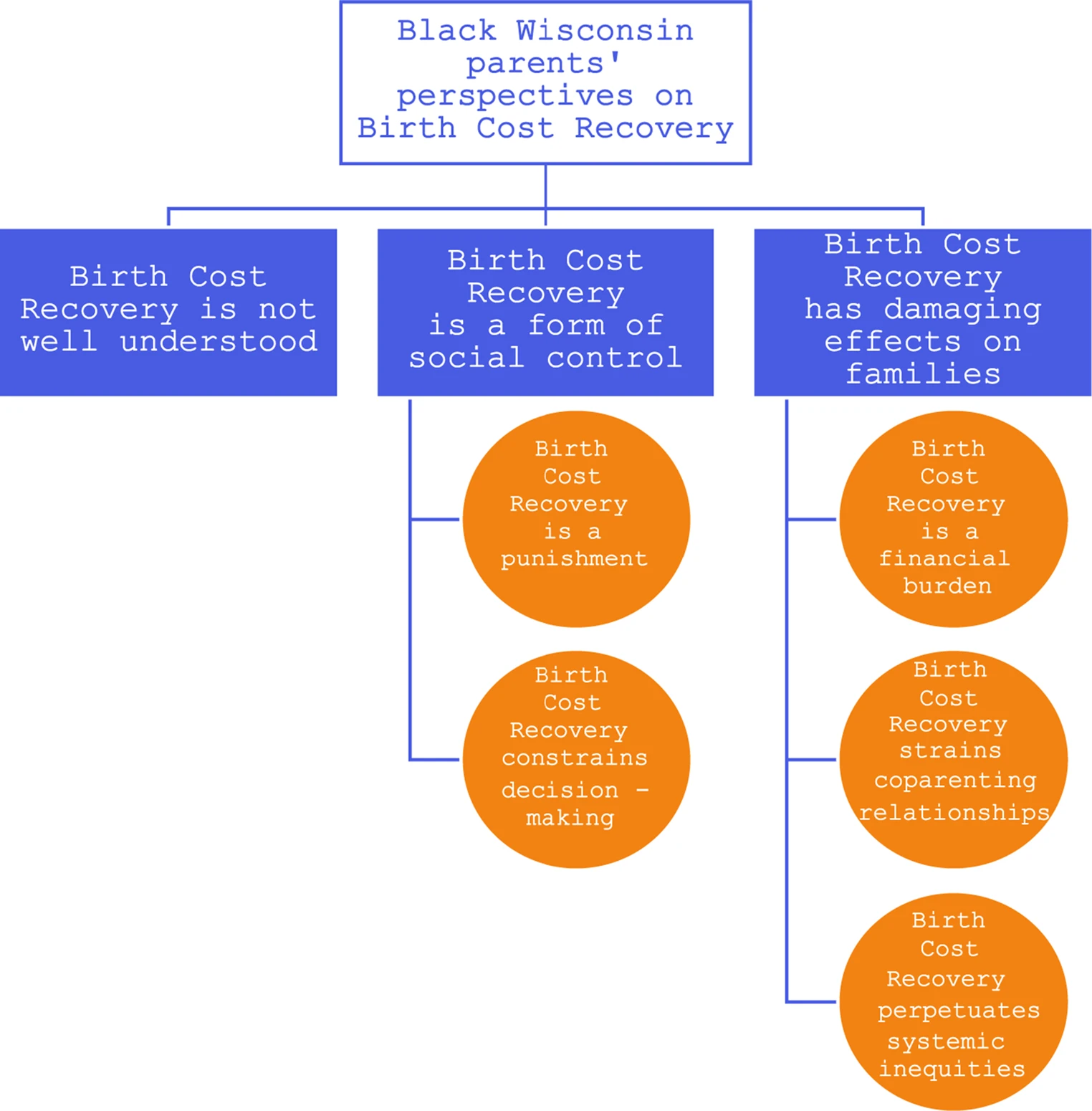
Themes and sub-themes identified through thematic analysis investigating Black Wisconsin parents’ (N = 40) experiences with birth cost recovery

The Future of Birth Cost Recovery in Wisconsin
The Future of Birth Cost Recovery in Wisconsin
In early 2025, Klaira Lerma led a Policy Research Brief on proposed state budget changes that could eliminate Birth Cost Recovery in Wisconsin.

Understanding the Impacts of Wisconsin’s Birth Tax: A Reproductive Justice Approach
Dr. Tiffany Green gave a lecture on Birth Cost Recovery and our research on the impacts of the policy on Wisconsinites.

Why You Need to Know About Birth Cost Recovery
Dr. Tiffany Green joined The Black Fatherhood Podcast with Dr. Alvin Thomas, which explores a range of topics central to Black fatherhood, to discuss Birth Cost Recovery.
Research Status
From 2022-2025, we conducted a community-engaged pilot study to better understand how Birth Cost Recovery impacts Black families in Wisconsin funded by the Wisconsin Partnership Program. This grant included the following data collection activities:
Interviews
First, we conducted 40 in-depth interviews with Black parents, both mothers and fathers, to understand their experiences with and perceptions of Birth Cost Recovery (learn more here).

Survey
Utilizing the rich qualitative data from these conversations, we designed a pilot survey for Black fathers in Wisconsin who had a child born in the last 10 years, whose birth expenses were paid for with public insurance (Medicaid, BadgerCare). We surveyed both fathers who were married at the time of the birth and those who were unmarried (and would have potential exposure to Birth Cost Recovery) to compare experiences. The survey asked about their relationship with both their child and co-parent, experiences with the healthcare system and child support, and their experiences with and perceptions of Birth Cost Recovery. The survey concluded in March 2024, and includes a sample of 130 Black fathers.

We are busy analyzing and interpreting the survey data and plan to submit a manuscript with the quantitative findings in Spring 2026. In late Summer 2026, we also plan to release a community report in plain language that includes results from both the interviews and survey.
Next Steps: We hope to harness the results of this pilot study to pursue funding for a larger state-wide evaluation of Birth Cost Recovery that examines the impact on pregnancy- and infant-health outcomes and the experiences of the policy among other vulnerable groups in Wisconsin (e.g., immigrants, additional racial minority groups).
Research Team
We are grateful for invaluable contributions from our many community partners, including Felica Turner-Walton and Tara Wilhelmi; our strategic advising consultant Annette Miller of EQT by Design; our Community Advisory Board members Brandice Hatcher, Patricia McManus, Debra Nevels, Carola Peterson-Gaines, Sharon Rice, and Jacqueline Sills Ware; our academic collaborators and thought partners Rachel Azanleko-Akouete, Gina Green-Harris, Obie Oniah, David Pate, Hoa Vu, Tova Walsh, Jasmine Zapata, and Katrina Kimport.
We also thank those that funded this work: the Wisconsin Partnership Program, the Wisconsin Department of Children and Families, and the Centennial Scholars Program at the University of Wisconsin School of Medicine and Public Health.
- Penalizing Parenthood and Perpetuating Poverty: Black Parents’ Perspectives on Wisconsin’s Birth Cost Recovery Policy
Swan LET, Lerma K, Strelitz-Block E, Miller M, Lewis F, Green TL. 2026. - The Future of Birth Cost Recovery in Wisconsin
Lerma K, Swan LET, Strelitz-Block E, Romell E, Green TL. 2025. - Effects of Medicaid Birth Cost Recovery Policy Changes on Child Support Outcomes
Green T, Cook ST, Vu H. 2023.
- Evers budget proposal would end clawback of Medicaid birth costs statewide
Wisconsin Examiner Interview | Klaira Lerma [April 2025] - Why You Need to Know About Birth Cost Recovery
Black Fatherhood Podcast Interview | Dr. Tiffany Green [December 2023] - Milwaukee County Stops Taking Fathers to Court to Pay Back Medicaid for Childbirth Costs
Wisconsin Examiner Interview | Dr. Tiffany Green [November 2023]